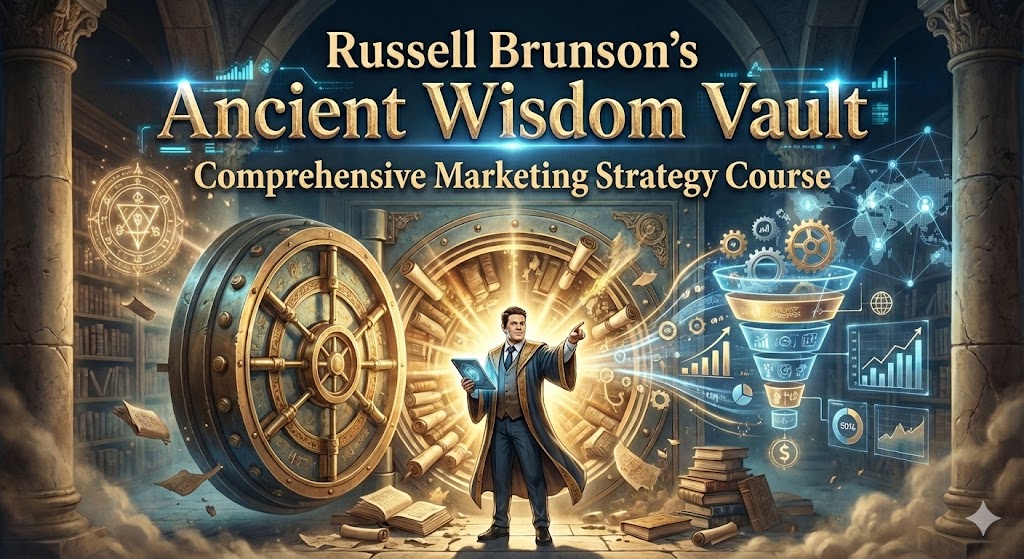
Learning Success from 100-Year-Old Books: Inside Russell Brunson’s Ancient Wisdom Vault
📚 Uncovering 100-Year-Old Success Secrets
How to Reprogram Your Subconscious Mind and Build Powerful Movements
📋 Table of Contents
💎 Introduction: Why Invest Fortunes in Old Books?
Meet Russell Brunson: A pioneer of modern digital marketing who has spent hundreds of thousands of dollars on over 18,000 old books and materials. He’s a passionate treasure hunter searching for ‘forgotten wisdom.’
Russell Brunson stands at the cutting edge of technology, yet he obsesses over 100-year-old dusty wisdom. Why? This goes beyond a collector’s passion – it’s a confident quest to reverse-engineer a massive secret.
This report dissects the fruits of that quest. The core of the integrated success system Russell discovered through countless ancient books is clear: The answer lies not in rapidly changing technology or fleeting trends, but in one principle that transcends time and governs human behavior – the method of reprogramming the subconscious mind.
Through this report, you’ll learn a coherent system from controlling your ‘inner subconscious’ – the foundation of success – to influencing the ‘outer subconscious’ that moves customers’ hearts and creates massive movements. Be prepared to encounter unique claims that completely overturn conventional wisdom. It’s time to awaken the wisdom of giants sleeping in old bookshelves and rewrite your success equation.
🧠 Part 1: Building Success Foundations – The Power of Thought
1.1. Everything Starts with Thought: You Are the Architect of Your Life
The starting point of all success strategies begins not with controlling the external world, but with mastering our inner world. The first key Russell Brunson discovered was this: To change your external environment, you must first redesign your inner subconscious.
“You are the architect of your own life.” – Charles F. Haanel, The Master Key System
Charles F. Haanel, a thinker from 100 years ago, clarified this principle in his masterpiece ‘The Master Key System.’ Just as an architect draws blueprints before building, our lives are created according to the design of thoughts in our minds. You can only build a house in reality after specifically imagining and designing what kind of house you want to live in.
Haanel asserts that ‘thought creates environment.’ Many people feel trapped by their environment, but what actually imprisoned them wasn’t the environment – it was a prison of thoughts they built themselves. The moment you realize this truth, you gain the power to become not a victim of circumstances, but an architect who creates life by reprogramming your own subconscious.
💡 Practical Application: Modeling
So how can we break down this old prison of thought and redesign our lives? Modern self-development master Tony Robbins provides the concrete blueprint through ‘Modeling’.
- Find someone already living the life you want
- Follow their thoughts and actions exactly
- This is like building your house by looking at a successful architect’s blueprint
- By modeling their thinking patterns, we can most effectively reprogram our subconscious
Now that we understand the powerful force of being our life’s architect, we’re ready to equip the engine that will turn that blueprint into reality – another inner power essential for success, though often misunderstood.
1.2. Healthy Egotism Essential for Success
‘Egotism’ or ‘Ego’ is often dismissed as a negative word in societies that value humility as a virtue. But when Russell Brunson opened Irving R. Allen’s 100-year-old book ‘The 10 Basic Laws of Success,’ he encountered another subconscious secret for winning in the fierce battlefield of business: powerful self-confidence, or ‘healthy egotism.’
Why Healthy Egotism Matters
Allen argued that to become a successful leader, you need ‘healthy egotism’ beyond simple confidence. This isn’t arrogant conceit, but an unwavering inner belief that can answer the question: “Why should people listen to me instead of countless competitors?”
Without this subconscious self-confidence, you can never lead people and create a movement.
“No man can accomplish great things in life unless he believes, in his private thoughts, that he is superior to all other men.” – Andrew Carnegie
Andrew Carnegie, one of the wealthiest men of his era, knew this secret too.
Of course, this powerful inner force requires delicate balance. Russell Brunson learned this balance point by experiencing a major failure, a ‘Cycle,’ early in his business.
With this powerful inner force, we’re now ready to anchor that power in reality with the determination to overcome any obstacle.
1.3. Determination Makes the Impossible Possible: “A Message to Garcia”
Obstacles inevitably appear on the path to goals. Most people stop before problems, complain, or beg for solutions. But the secret Russell discovered in Elbert Hubbard’s old book ‘A Message to Garcia’ was that the successful few have their subconscious programmed to complete missions under any circumstances.
📖 The Story of Lieutenant Rowan
The story begins with U.S. Army officer Lieutenant Rowan receiving a mission to deliver a message to General Garcia in the Cuban jungle. He didn’t ask a single question like “Where is he?” or “How should I get there?” He simply took the message and, through any difficulty, found his own way and completed the mission. This is the attitude of successful people. They don’t ask ‘how’ – they ‘just do it somehow.’
💡 The Etymology of “Decide”
This attitude holds a secret in the etymology of the word ‘decide.’ The origin of ‘decide’ is ‘to cut off.’ A true decision is the act of cutting off all other possibilities, excuses, and escape routes, leaving only the path forward. But most people don’t decide – they just ‘dabble,’ keeping a back door open in case of failure.
“To take the island, burn the boats.” – Tony Robbins
Tony Robbins explains this with the metaphor: “To take the island, burn the boats.” When you burn the boats for retreat, taking the island becomes no longer a matter of choice, but a ‘must’ for survival. This is a powerful ritual that sends a signal to your subconscious that there’s no retreat, reprogramming yourself to accept no outcome other than success.
When you become the ‘architect of thought’ taught by Charles Haanel, arm your inner self with Irving Allen’s ‘healthy egotism,’ and burn your retreat with Elbert Hubbard’s ‘determination,’ you finally earn the right to influence others’ subconscious minds.
🎯 Part 2: The Art of Persuasion – Timeless Marketing Secrets
2.1. Persuade with Emotion, Not Logic: Opening the Door to the Subconscious
We believe we communicate logically at a conscious level, but what actually determines our actions and purchases isn’t reason – it’s emotion and the subconscious. When Russell discovered Walter Dill Scott’s ‘The Psychology of Advertising,’ published in 1913, he held in his hands the key to opening not customers’ wallets, but their hearts. That key was understanding and reprogramming customers’ subconscious minds.
The 3-Step Subconscious Reprogramming Process
Scott argued that advertising and marketing must start from understanding human psychology, especially the beliefs and patterns deeply ingrained in our subconscious. Customers’ subconscious minds are filled with ‘stories’ formed from past experiences, and these govern their current behavior.
Therefore, the most effective way to persuade customers is to break the ‘chains of false beliefs’ embedded in their subconscious and plant new beliefs.
- Identify False Beliefs: Find preconceptions or negative beliefs customers have about your offer. (e.g., “Online business is too complex and difficult.”)
- Analyze Experiences: Understand which past negative experiences caused those beliefs. (e.g., “I took an online course before, wasted money, and got nothing.”)
- Story Confrontation: Tell your story powerful and positive enough to overwhelm customers’ negative stories. Reprogram their subconscious through your success story and make them believe in new possibilities.
💼 Russell’s MLM Story Example
Russell Brunson used this method to overcome people’s negative perceptions of multi-level marketing. He shared his own story: “I also hated calling friends like you do. But I found a new way using the internet – explaining opportunities only to people who contacted me first. As a result, I became #1 in the company within 90 days and received a Ferrari.”
This completely overturned existing negative beliefs and planted new ones.
Now that we’ve opened the door to customers’ subconscious, it’s time to learn what and how to propose most effectively.
2.2. Offer ‘New Opportunity’, Not ‘Better Product’
In a fiercely competitive market, shouting “Our product is better” only triggers warning lights in customers’ subconscious. The most powerful insight Russell learned from modern marketing master Dan Kennedy was that the strategy to change the market game isn’t offering something ‘better,’ but presenting a completely ‘New Opportunity.’ ‘Improvement’ breeds debate, but ‘new opportunity’ breeds hope.
📊 Dan Kennedy’s 3-Level Offer Types
| Offer Type | Concept | Car Example |
|---|---|---|
| Repair | Fixing what’s broken | “We’ll repair your broken car.” |
| Improvement | Offering something better than existing | “Drive a new car faster than your old one.” |
| New Opportunity | New paradigm completely replacing old ways | “Stop driving. We’ll teach you to fly.” |
💡 ClickFunnels’ New Opportunity Strategy
Russell Brunson didn’t position ClickFunnels as ‘a better website builder tool.’ Instead, he threw ‘sales funnels’ as a new opportunity into the market, declaring “The age of websites is over. Now it’s the age of sales funnels.”
The moment you present this new opportunity, ‘websites’ – the old way – naturally become the ‘public enemy.’
This is like Steve Jobs presenting the iPod not as ‘an MP3 player holding more songs,’ but as a new experience: ‘1,000 songs in your pocket.’ The moment you present a ‘new opportunity,’ you become a unique ‘Category of One’ with no competitors.
But the ‘vehicle’ of new opportunity alone isn’t enough. People need a ‘destination’ – who they want to become by riding that vehicle.
2.3. Sell ‘Identity’, Not Product
When Russell opened Edward Bernays’ 100-year-old book ‘Propaganda,’ he encountered one of modern marketing’s most powerful secrets: People buy identity, not products. They don’t buy a product’s features – they purchase the new identity and belonging they’ll gain by using that product.
🚬 Bernays’ Cigarette Campaign
Called ‘The Father of PR,’ Bernays connected cigarettes with the identity of ‘women’s independence and liberation.’ He had influential women smoke cigarettes like ‘torches of freedom’ in parades, and women purchased not cigarettes, but the identity of ‘independent new women.’ This was a powerful technique linking products and identity in the public’s subconscious.
🎯 ClickFunnels’ Identity Marketing
ClickFunnels also used this strategy as a core element. They didn’t simply call software users ‘customers’ – they defined them as a special group with the identity of ‘Funnel Hackers.’
Then they gave away t-shirts printed with “Funnel Hacker” for free. This wasn’t just merchandise. It was a symbolic act of dressing customers in a ‘superhero cape.’ By wearing the t-shirt, customers accepted a new identity and became proud members of the ‘Funnel Hacker movement’ to change the world.
If ‘new opportunity’ tells them what they _do_, ‘new identity’ shows them who they _become_. Having granted this powerful identity, we now need the final glue to bind them together.
2.4. Building Strong Communities: Creating a Common Enemy
This concept may sound somewhat dark, but according to what Russell discovered in social philosopher Eric Hoffer’s works, it was historically the most effective method for creating mass movements.
“Mass movements can rise without a belief in God, but never without a belief in a devil.” – Eric Hoffer
The shocking insight is that what unites people most quickly and powerfully isn’t ‘love,’ but ‘hatred’ toward a common enemy. To create a powerful ‘us’ identity, we need a clear ‘them’ – a definite ‘common enemy’ to fight together.
🎯 ClickFunnels’ Evolving Common Enemies
Russell Brunson strategically utilized this principle to unite the ClickFunnels community, evolving the ‘common enemy’ by era:
- Early Stage: Presented ‘sales funnels’ as a new opportunity and set ‘websites’ – the ‘old way’ – as the enemy
- Middle Stage: Set ‘competitors’ like LeadPages and InfusionSoft as enemies to stimulate community competitiveness
- Current: Setting ‘conceptual enemies’ like venture capital and ‘drifters’ who settle for reality, giving the community a higher sense of mission
By synthesizing these timeless principles, Russell Brunson completed a modern success system for reprogramming the subconscious.
⚡ Part 3: Unique Claims and Their Evidence – Overturning Conventional Wisdom
This section intensively analyzes the three most unique and controversial claims Russell Brunson discovered in old books that differ from today’s common sense, presenting their concrete evidence.
Claim 1: “Healthy Egotism is Essential for Success”
🎯 What Makes This Unique?
This claim directly contradicts the general social norm to ‘always be humble.’ While many self-development books emphasize humility, this claim states that belief in inner superiority is an essential condition for great achievement.
📚 Specific Evidence
- Source: Irving R. Allen’s ‘The 10 Basic Laws of Success’
- Core Content: Business is like a battlefield where countless competitors fight for customers’ attention. Without powerful self-confidence beyond confidence and positive attitude – ‘egotism’ – you cannot lead people and create movements. This is a state of being certain of your own value and abilities at the subconscious level.
- Supporting Evidence: Andrew Carnegie’s quote supports this: “No man can accomplish great things unless he believes, in his private thoughts, that he is superior to all other men.” Russell Brunson’s experience mentally arming himself to beat competitors during his wrestling days and early business shows that you must have a powerful ‘egotism’ sword within for success.
Claim 2: “‘New Opportunity’ is Overwhelmingly More Powerful Than ‘Better Product'”
🎯 What Makes This Unique?
This claim differs from traditional business thinking centered on improvement: “Build a better mousetrap and the world will beat a path to your door.” While most companies focus on ‘better’ products, this claim demands changing the competitive game itself.
📚 Specific Evidence
- Source: Dan Kennedy’s ‘Opportunity Concepts’ course
- Core Content: Customers respond far more explosively to ‘New Opportunity’ that solves their problems in completely new ways, rather than products slightly improving existing problems. ‘Improvement’ means competition within existing markets, but ‘new opportunity’ creates new markets and makes competition itself meaningless.
- Supporting Evidence: The most powerful proof is Russell Brunson’s explosive success introducing ClickFunnels to the market not as ‘a better website builder’ but as the completely new concept of ‘sales funnels.’ This was a strategy to escape existing website competition and become king of the new ‘funnel’ category.
Claim 3: “‘Hatred’ is the Most Powerful Force Uniting People”
🎯 What Makes This Unique?
This highly controversial claim directly contradicts general leadership theory that communities should be led with ‘positive vision’ and ‘love.’ Contrary to the notion that leaders should speak of hope, it says anger and hatred are more effective motivators.
📚 Specific Evidence
- Source: Edward Bernays and Eric Hoffer’s mass movement theory
- Core Content: To create a powerful ‘us’ identity, you need a clear ‘common enemy’ – a ‘them.’ Hatred toward a common enemy acts as the unifying agent that most quickly and effectively binds members’ subconscious emotionally.
- Supporting Evidence: Russell Brunson’s concrete case of strategically changing the ‘common enemy’ by era to unite the ClickFunnels community of ‘Funnel Hackers’ proves this. He set ‘websites’ as enemies early on, then ‘competitors,’ and currently ‘venture capital’ or ‘drifting people’ as conceptual enemies, continuously strengthening community cohesion.
🌟 Conclusion: The New Path to Success from Ancient Wisdom
Russell Brunson’s journey into the shelves of 18,000 old books leaves us with an important lesson. The true secret of success isn’t rooted in rapidly changing technology or flashy trends, but deeply in principles of human subconscious and behavior that remain unchanged even after 100 years.
🎯 The Integrated Success System
- Inner Foundation: Realize the truth that ‘thought creates reality’ and reprogram your subconscious with healthy egotism and determination
- Outer Influence: Persuade others’ subconscious with emotion not logic, present ‘new opportunity’ not ‘better product’
- Movement Building: Sell ‘identity’ not product, unite communities through ‘common enemy’
💡 Final Insight: Perhaps the most innovative success strategy is exploring not the future, but the past. Exploring the ancient wisdom on your bookshelf or sleeping in forgotten corners of bookstores may be the newest path to fundamentally transforming your life and business.
The wisdom of giants isn’t found only in new bestsellers. Sometimes the most valuable insights lie dusty on old shelves, waiting to be rediscovered. Start your treasure hunt today – your next breakthrough might be hiding in a 100-year-old book.