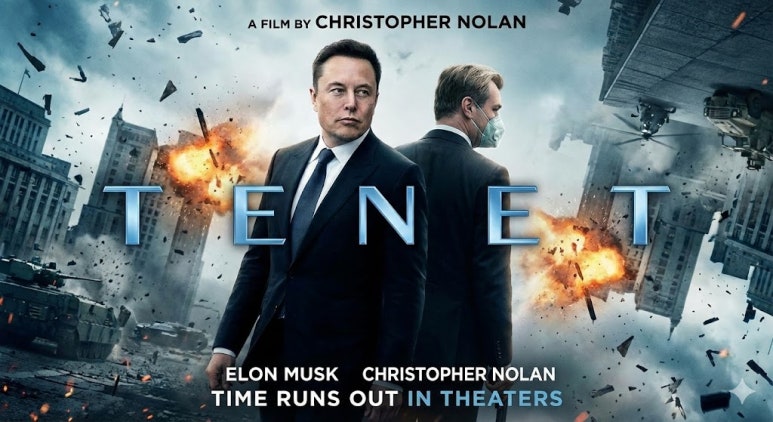
Elon Musk vs Christopher Nolan
A Chilling Parallel Between Two Geniuses: Space vs Time, Simulation vs Determinism
“Have these two ever met in person?”
That was the question that sparked this thought experiment.
On one side stands Elon Musk,
one of the most influential engineers and technologists alive.
On the other stands Christopher Nolan,
arguably the most intellectually ambitious filmmaker of our time.
Both obsess over physics, dimensions, and the limits of human existence.
So naturally, the question arises:
Have they ever crossed paths?
Fact Check: They Have Never Met
There are no confirmed interviews, photos, or collaborative projects linking the two.
No public meetings. No private conversations on record.
And yet, the deeper you look, the more unsettling the coincidence becomes.
Even if their bodies never met,
their minds appear to occupy the same conceptual space.
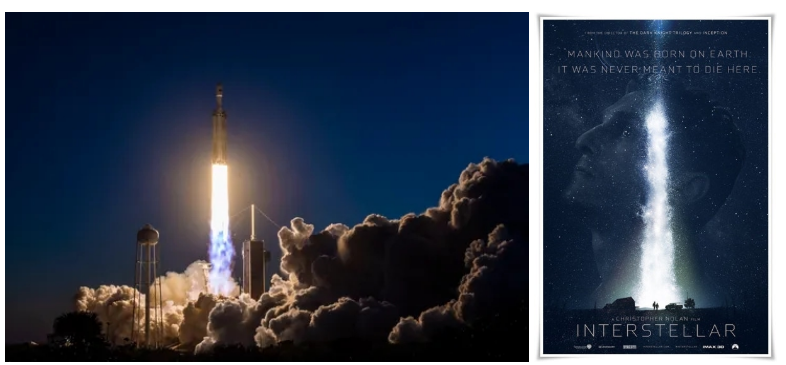
1. The One Who Tears Through Space vs the One Who Folds Time
Musk has openly praised Nolan’s scientific rigor, particularly in films like Interstellar and Inception.
But their intellectual axes point in opposite directions.
This contrast reveals something profound.
🚀 Elon Musk — Space
- Space + X (the unknown variable)
- Core question:
“How far can humanity expand outward?”
SpaceX is not just a company name.
It is a declaration: expansion into the unknown.
Notice something curious—
time is absent from the equation.
For Musk, time is not something to contemplate.
It is a constraint to be overcome on the way to Mars.
⏳ Christopher Nolan — Time
- Time, Memory, Causality
- Core question:
“When are we living, and how do we perceive it?”
In Nolan’s films—Interstellar, Inception, Dunkirk, Tenet—
time is not a backdrop.
Time is the protagonist.
Where Musk accelerates outward,
Nolan compresses inward.
At a Glance
| Dimension | Elon Musk | Christopher Nolan |
|---|---|---|
| Focus | Space | Time |
| Method | Engineering, Physics | Narrative, Cognition |
| Direction | Expansion (Outward) | Compression (Inward) |
| Symbol | Rocket | Clock |
2. A Curious Parallel Through Eastern Philosophy
An intriguing coincidence emerges when viewed through an Eastern lens.
Both men were born in the early 1970s, in midsummer—
a period traditionally associated with yang (active, outward energy).
- Elon Musk: June 28, 1971
- Christopher Nolan: July 30, 1970
Metaphorically speaking:
- Musk resembles fire, melting metal and propelling humanity outward through explosive force.
- Nolan resembles water, flowing through time, containing memory within carefully constructed structures.
One splits the universe vertically through space.
The other folds it horizontally through time.
It is difficult not to wonder:
what would happen if these two energies ever truly met?
3. Simulation vs Determinism: A Philosophical Collision
If Musk and Nolan ever shared a long night of conversation,
it would likely revolve around a single question:
Is our fate predetermined?
Musk: The Simulation Hypothesis
Musk has repeatedly argued that reality is likely a simulation.
“The odds that we’re in base reality are extremely low.”
In this worldview:
- The universe is a system.
- Technology is the cheat code.
- Escape—or transcendence—is possible.
The world is a prison,
but one with vulnerabilities.
Nolan: Determinism
Nolan’s answer comes most clearly in Tenet:
“What’s happened, happened.”
This is a deterministic universe.
- Structures cannot be rewritten.
- Meaning emerges not from escape, but from understanding.
Not fleeing the system—
but accepting and interpreting it.
The Core Divide
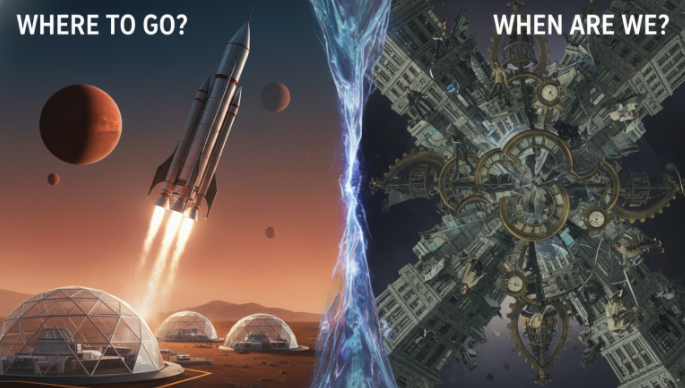
- Musk asks: Where can we send humanity?
- Nolan asks: When are we actually living?
Escape versus comprehension.
Transcendence versus meaning.
4. Their Hidden Similarity
Despite appearing as opposites, they share a striking belief:
Neither places humanity at the center of the universe.
For Musk, the universe is cold and indifferent—
so we must build technology to survive it.
For Nolan, the universe is silent and unresponsive—
so we must create stories to endure it.
One builds rockets.
The other builds narratives.
Both respond to cosmic indifference in their own way.
If They Ever Meet
In Eastern philosophy, yin and yang do not destroy each other.
They complete each other.
If Musk’s mastery of space were to merge with Nolan’s philosophy of time,
we might finally glimpse a deeper answer to a timeless question:
Why should humanity go to space at all?
Tonight, I’ll watch a Nolan film
while imagining satellites launched by Musk passing silently overhead.
Which worldview draws you in more—
the desire to escape the system,
or the urge to understand it?