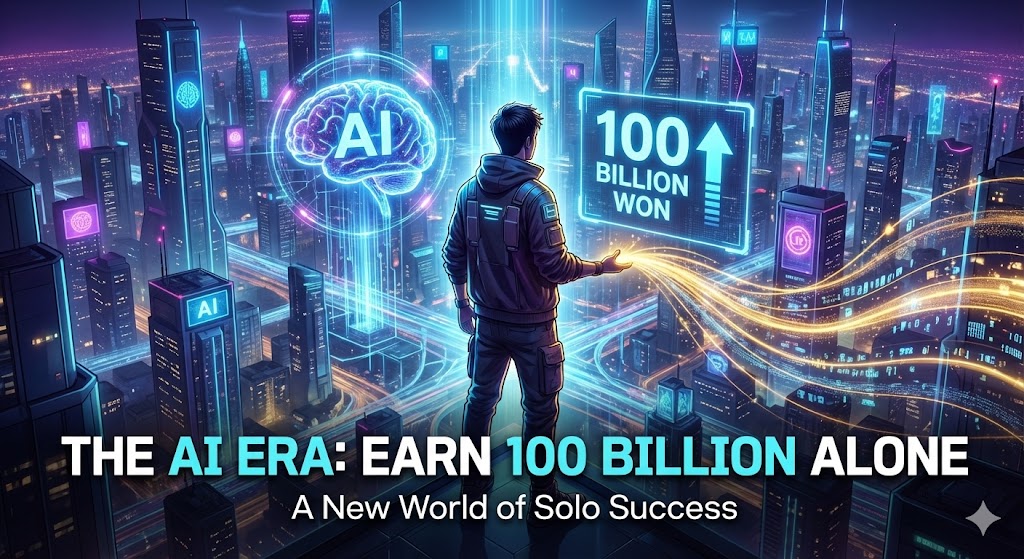
The AI Era: An Age Where One Person Can Earn $100 Billion
Mindminer Song Gil-young on the Era of ‘Lightweight Civilization’
📌 Table of Contents
- 1. Introduction: 2026, A Changed Landscape
- 2. Think Twice Before Hiring More Than 10 People
- 3. The Era of Infinite Supply, Insufficient Consumers
- 4. An Era Where Individuals Compete with Organizations
- 5. Sam Altman’s Declaration: “Making a Trillion Alone”
- 6. The Crisis of Manager Kim at a Large Corporation
- 7. Fundamental Changes in How We Work
- 8. The Era of Teenage Entrepreneurs
- 9. The Collapse of the Education System
- 10. Strategies for Survival
- 11. What Should People in Their 50s Do?
- 12. How Should the Next Generation Prepare?
- 13. Conclusion: Toward a Warm Civilization
Introduction: 2026, A Changed Landscape
The year 2026 has begun, but this is not a year where we can simply resolve to improve our attitude and mindset. We’ve entered an era where we must fundamentally change what we do, overhaul our companies, and rethink our careers from the ground up. At the center of it all is artificial intelligence.
Mindminer Song Gil-young says, “Even though it’s January of this year, the media and large organizations keep asking questions as if hearing it for the first time: ‘Is it true that AI will change the world?’ Now organizations are actually moving. They’re feeling that it’s really here.”
1. Think Twice Before Hiring More Than 10 People
Song Gil-young’s “Era Forecast” series has evolved through editions C and D to arrive at the keyword “lightweight civilization.” His message is clear:
“You need to think twice about hiring more than 10 employees. It’s unconditionally excessive.”
This is because collaboration systems are becoming highly sophisticated. Until now, to do something, you had to bring in someone who was good at it. If they didn’t want to come, you gave up. But things are different now. With AI’s help, the scope of what an individual can do has expanded explosively.
“Making games has become easier, creating websites has become easier than before. The need to bring in people is decreasing. Now the battlefield has become almost infinite.”
An Era Where You Can Make a Movie for $20,000
Remarkable things are happening at recent AI film festivals. High school students are becoming film directors and winning awards. At a film festival hosted by a telecommunications company, an incredible one thousand films were submitted. Director Kyung Yu-sung created the feature film “Middle World” entirely with AI and won an innovation award in the UK.
To make a Jurassic Park-like movie, you just need to pay AI about $1,000. Including labor costs, $20,000 is sufficient. But here’s where a problem arises: The number of movies in theaters has increased, but the audience hasn’t grown.
2. The Era of Infinite Supply, Insufficient Consumers
YouTube already has over 65 million channels. The number of subscribers hasn’t decreased, but revenue isn’t coming in. It’s because entertaining content is overflowing everywhere.
“We’re seeing for the first time what happens to our economic system when supply becomes infinite. Until now, supply was always insufficient, but now supply is infinite while there aren’t enough consumers.”
Who Gets Hit First?
Industries with complex production processes that used many resources are struggling. In the film industry, the CG sector is being hit first. As special effects costs have drastically decreased, previously heavy parts have become targets for weight reduction.
“Conversely, industries that were profitable are now at risk. Why were they profitable? Because they were large-scale. But now that scale has become a burden.”
3. An Era Where Individuals Compete with Organizations
Song Gil-young’s Era Forecast series has evolved as follows:
- Edition C: Core Person (核人) – Go alone. Live long.
- Edition D: Naming Society – Cooperation through mutual respect and recognition
- Forecast: Lightweight Civilization – AI-augmented individuals compete with organizations
Now both individuals and organizations have begun to think they don’t need each other. Organization members are working hard on side projects, and companies are exploring AI-based reengineering. Both sides have made a “decision to break up”.
“Individuals have awakened and been augmented with AI. In the past, if you said ‘I quit,’ you struggled as a self-employed person or freelancer. Now individuals have become like riding Gundams. Individuals have become organizations.”
4. Sam Altman’s Declaration: “Making a Trillion Alone”
OpenAI CEO Sam Altman made a shocking statement: “One person can make a trillion.”
In the past, to make a trillion, you had to invest heavily and increase employment. You had to invest 20 trillion to make one trillion. But now it’s different. You just create one service by yourself and then multiply it.
Real Case: Base44
Base44, which makes coding tools, had just one member. Yet it achieved $5 million in revenue and was sold for $100 million in just 6 months. In the past, exit took 4-5 years, but now 6 months is enough.
“Business models have emerged where the human factor has been removed. This means the income gap between smart and not-so-smart people will widen tremendously.”
5. The Crisis of Manager Kim at a Large Corporation
In 2025, two pieces of content resonated deeply: “The Story of Manager Kim at a Large Corporation with a Home in Seoul” and director Bu Chae-sun’s “Can’t Help It.” Combined, they deliver this message:
“Manager Kim at a large corporation with a home in Seoul resigning is inevitable.”
Manager Kim feels he’s ground his life into the company for 25 years. He did all the difficult tasks for his seniors, never attended his children’s graduations but always went to his seniors’ graduations. But now the company says, “We have AI, so we don’t need you.”
What’s more frustrating is being pushed out by AI, something that’s not even human.
The Company Strikes Back
- Electronics companies: Early retirement from age 50
- Aviation companies: From age 45
- Financial firms: From age 40
- Retail companies: Anyone (including those in their 20s)
The atmosphere is tense. “Manager Kim, can you help with this?” “Me? Today? Why? Why me?”
6. Fundamental Changes in How We Work
Canva for Presentations, Sora for Videos
What’s happening now?
- Presentation creation → Canva (replacing design teams)
- Video production → Sora (replacing multimedia teams)
- Software development → Cursor (replacing development divisions)
- Sales/Customer management → Gong (replacing sales teams)
“What five designers used to do has been serviced as five agent teams working. Agents will likely become colleagues now.”
24/7/365 Working Colleagues
AI agents don’t sleep or eat. They work without weekends. The era when online shopping customer service was from 9 AM to 4 PM is over. If competitors start 24-hour service, you can’t avoid doing the same.
“This is a kind of prisoner’s dilemma. If the other side does it, you have no choice but to do it too.”
7. The Era of Teenage Entrepreneurs
Calorize AI – $2 Million Revenue App Made by High School Students
Three high school students created “Calorize AI,” an app that calculates calories immediately when you take a photo. In October and November of last year, monthly revenue reached $2 million. They completed it without any funding.
“We need to think about what we’ll do in a system where anyone can produce. It means there are people going without funding.”
An 18-Year-Old Musician’s Global Success
The case of an 18-year-old is even more remarkable:
- Created cover art with PaintDotNet and Procreate
- Sampled with Splice, synthesizer work with Serum 2
- Completed music with FL Studio
- Distributed with DistroKid (Apple Music, Spotify, etc.)
- Gained 30,000 fans on YouTube
- Communicated with fans via Discord
- 1.3 million page views, $5,000 revenue
They did everything from distribution to monetization alone. In the past, you’d have to audition and spend 10 years as a trainee. Now you can start immediately.
8. The Collapse of the Education System
“Do I Really Need to Go to College?”
The high school student who made Calorize AI has already completed their own business. So should they go to college? In the past, the logic “you need a diploma to apply for jobs” worked. But not anymore.
“I’ve already done business, started a one-person company, so do I really need to go?”
The Palantir CEO’s Provocation
The Palantir CEO announced the “Palantir Fellowship”:
- Only high school graduates can apply (college graduates cannot)
- 4-month education (reading, data interpretation, discussion, religion, history, etc.)
- Guaranteed employment after training
“Four years of education is parasitic. We’re wasting too much time learning.”
His argument is clear: University should be enough to learn how to learn, not a place to learn. Because AI will teach the knowledge.
AI Tutors vs Active Learning
A randomized controlled trial at Harvard University showed that AI tutors were more effective than professors’ intensive tutoring. This is because personalized learning is possible.
“Now you hear all the explanations at home and come to school to discuss and express opinions. Lectures disappear and only discussion and nurturing remain.”
9. Strategies for Survival
What Should You Do at Age 25?
Song Gil-young provides a clear answer:
“Determine your home base quickly.”
Until now, the narrative “I’m a quick learner and can do any task” worked. Not anymore.
“You need to bring evidence as a portfolio, saying ‘We know how to do this. We’ve even done it before.’ You need to do whatever comes your way. But limit the range of what comes your way.”
Work As If You’ve Already Been Hired
- Clearly define your area of interest
- Gain actual project experience in that field
- Participate in small organizations, part-time work, or projects
- Create results you can prove with a portfolio
“You need to observe how your home base exchanges value in society. Otherwise, you might devote yourself to something meaningless in the real economy.”
The End of New Graduate Recruitment
Many companies have started eliminating new graduate recruitment. They don’t conduct in-depth company training as before. Now they only hire experienced workers.
“If you know how to work, you can enter; if you don’t know, you can’t. They don’t ask about education. If you’re already good at it, what does it matter where you spent your 20s?”
10. What Should People in Their 50s Do?
Choosing Between 3 Years vs 60 Years
Many people ask: “The early retirement compensation is quite large. Should I stay and get it, or leave?”
Song Gil-young’s answer:
“Don’t focus on 3 years, look at the 60 years beyond that. Even if you leave after 3 years, you won’t die for another 60 years. You need to prepare for the next step.”
Whether you leave or not, you need to explore what you can do afterward. Not just for income, but for self-esteem and social role.
Are Large Corporations Still Valid?
“The probability is low. Because total employment is decreasing, they can’t be as generous as before about letting people in.”
But what matters is not scale but density.
“Airplanes can fly even when large, pebbles fall down even when small. You need to look at whether that company can fly, its future potential, internal organizational culture, and business type before joining.”
Companies Are No Longer Communities of Shared Destiny
You can go to a large corporation. But after about 3 years, if you’ve learned a lot, you move elsewhere. You design your entire career and refuel at various places—you don’t become a community of shared destiny.
11. How Should the Next Generation Prepare?
Changing Parental Roles
In the past, when graduating high school was higher education, parents couldn’t teach their children anything. So they just cooked meals, cheered enthusiastically, stuck taffy for exams, and prayed. That was enough.
But the current generation has more thoughts as more people go to college. They want to send their children to better schools and prepare in advance. But this can actually limit possibilities.
“I think it’s time to tell the next generation to just figure it out themselves.”
The Trap of Coding Education
Many parents say “let’s teach coding.” But paradoxically, coder is the first job that will disappear. Because AI does all the coding.
“Coding for logic and thinking is meaningful. But the thought ‘computers are becoming important so let’s learn coding’ is not right.”
Making What You Love Your Career
Until now, the attitude was “do what you love as a hobby, and have a separate job.” Now you need to make a career out of what you love.
Parents discouraged it because they lacked confidence. They pushed people toward conventional paths, saying “you might starve selling udon.” But now, pushing toward conventional places without that confidence is a big problem.
“People who really love udon will have business even in the mountains. Just build a brand. AI will handle medium value, so you need to be an outlier. You’ll reach a state where doing what you love becomes your livelihood.”
Conclusion: Toward a Warm Civilization
Song Gil-young describes this change as a ‘warm civilization’.
“In the past, if you wanted to do music but couldn’t get into a music company, you couldn’t do it. Applications had underlying messages like ‘your age is burdensome.’ Now ‘forget it, I’ll do it alone’ is possible. It’s actually a warmer civilization.”
But there’s a condition: You can’t have someone tell you what to do. The good thing about organizations was being together meant eating together and being able to ask for help. Now you have to do everything yourself.
Key Messages
- Strengthen your ability to complete things alone from start to finish
- Adopt the mindset of going with AI
- Determine your home base quickly and dig deep
- Prove with portfolios
- Find what you love
- Live with an attitude of lifelong learning
In the era of lightweight civilization, heavy organizations can’t fly. But light individuals can soar high with AI wings. What matters is preparation. You can’t still be looking at nautical charts when GPS has arrived.
“Let’s use GPS. It’s AI. We must use it.”
In 2026, we stand at a civilizational turning point. There’s no need to be afraid. Rather, it’s an opportunity. A new era has opened where you find your own home base, collaborate with AI, and make a living doing what you love.
Now the choice is yours.